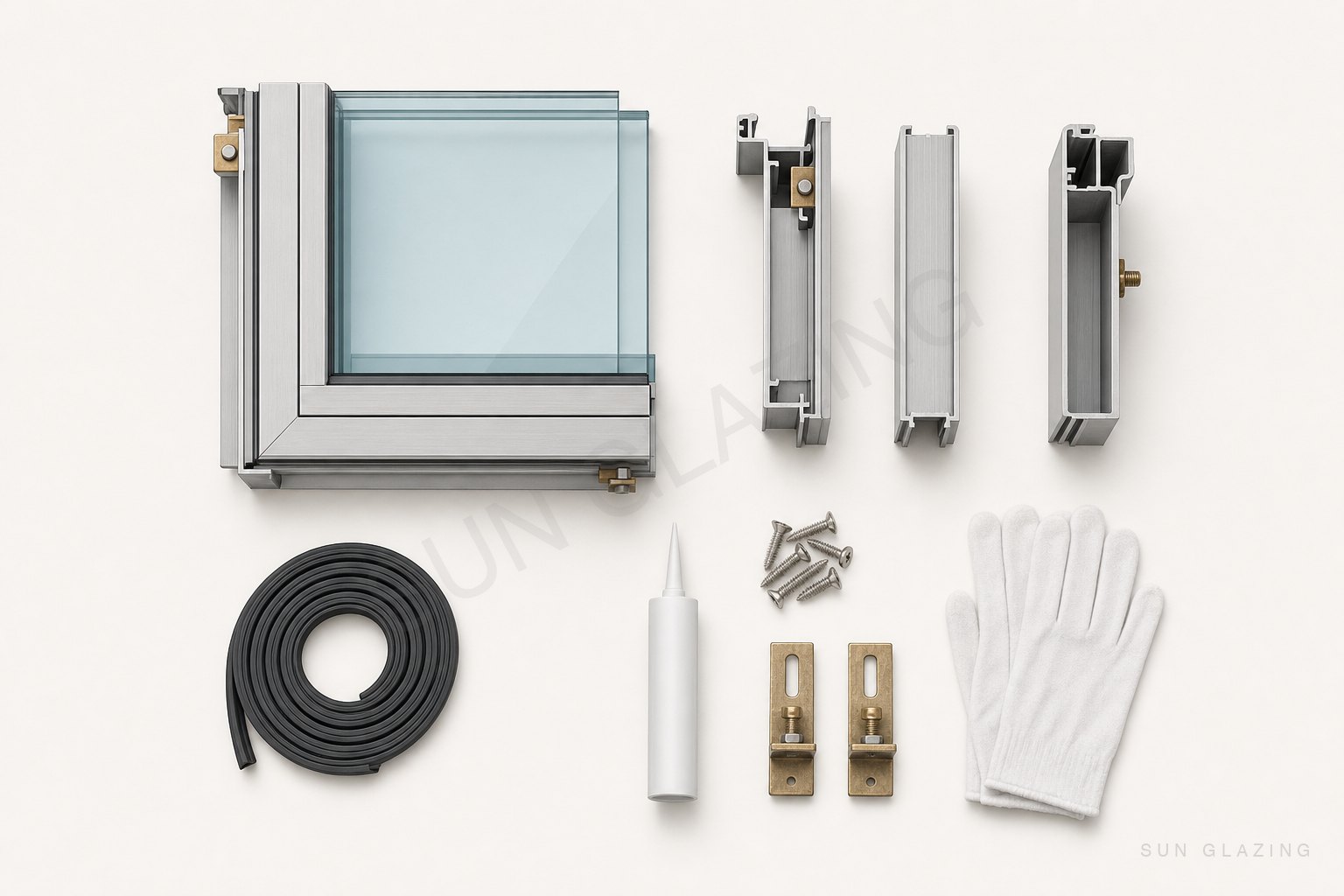
Ask five contractors to price the same elevation and the numbers can differ by half. Clients often read that spread as negotiation room. More often, it is five different buildings wearing the same drawing. A facade price is a stack of engineering decisions, and knowing the stack is the best protection a developer has. These are the levers that actually move the number.
1. The system itself
Whether the wall is stick, semi-unitized or unitized is the single largest structural driver — not just of price, but of programme. A unitized wall carries more factory cost and less site cost, closes floors far faster, and performs better; on tall buildings the programme saving routinely outweighs the premium.
2. Glass specification
Glass is typically the largest single material line. Clear float, high-performance low-E coatings, double-glazed units, heat-strengthening versus tempering, laminated interlayers for safety or acoustics — each step changes both cost and the building's energy bill for decades. A facade contractor should be able to show the thermal maths, not just the price delta.
3. Aluminium sections and wall thickness
Wind load, spans and deflection limits size the mullions. This is where cheap bids hide their savings: a section drawn at 2.5 mm wall thickness priced at 2.0 mm looks identical in a rendering and behaves very differently in a cyclone. Insist on the structural calculations — ours are done in-house and shared.
4. Hardware, gaskets and sealants
The facade's moving and sealing parts age fastest, and brand substitution here is invisible on handover day. We hold makes lists — the premium brands we quote are the brands that arrive, with no deviations.
5. Mock-ups, testing and engineering
Design engineering, mock-ups and chamber testing are a small share of facade cost — low single digits — yet they are the first lines deleted from a losing bid. Deleting them does not remove the cost; it moves it into the leak-chasing years, with interest.
6. Installation and access
Cranage, cradles, sequencing and the installers themselves. In-house crews cost more than day-rate labour and are the difference between the tested performance and the installed performance.
Reading a facade quote
Compare specifications before comparing totals: glass make and coating, aluminium wall thickness, system type, hardware brands, what is mocked up, what is tested, who installs. When two bids still differ after that list matches, the cheaper one has usually deleted something the list doesn't show.
We are happy to price transparently against a specification — or better, to help shape the specification before it goes to tender, which is where most of a facade's cost is truly decided.
← All posts