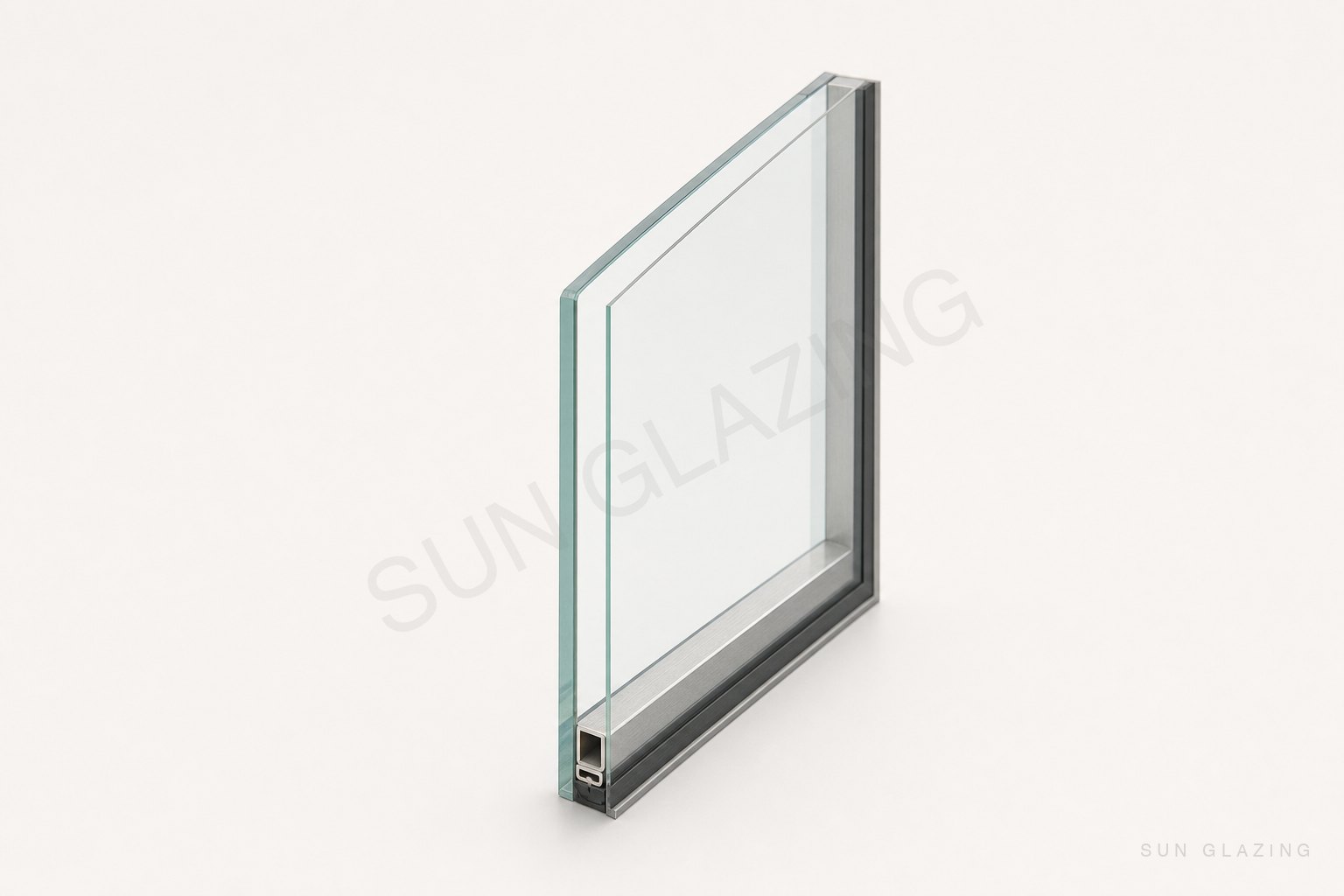
Glass is the single biggest line in most facade budgets and the biggest lever on the building's electricity bill for the next thirty years. It is also where Indian projects most often copy specifications from climates that have nothing in common with ours. Here is how we think about glass for buildings that live in forty-degree summers.
The number that matters here: SHGC
European specs obsess over U-value — how fast heat conducts through the glass — because their problem is keeping warmth in. Hyderabad's problem is radiation: the sun pouring heat through the glazing. That is measured by the solar factor (SHGC, or g-value): the fraction of solar heat that gets inside. Every 0.1 you shave off the SHGC of a big west elevation is air-conditioning tonnage you never buy and never run. U-value still matters for conditioned buildings — but in India, SHGC leads.
Low-E coatings: the working part of modern glass
A low-E coating is a metallic layer thinner than a wavelength of light. The critical distinction: solar-control low-E reflects the sun's infrared before it enters — built for our climate; passive low-E traps interior warmth — built for Scandinavia. They look similar in a brochure. Specify the wrong one and the glass works against the building. Alongside heat, check the visible light transmission (you want daylight without glare) and the coating's colour rendering — the best modern coatings are almost neutral.
Single, double, and where the money goes
A double-glazed unit (DGU) — two panes with a sealed, dehydrated cavity — roughly halves conducted heat and, with the coating on the cavity face, protects the low-E layer forever. For air-conditioned offices, hospitals and hotels, DGUs with solar-control low-E are simply the correct answer, and the AC savings amortise them. The bonus nobody prices in: acoustics. A well-made DGU turns an arterial-road frontage into a quiet room.
Tempered, heat-strengthened, laminated
Strength and safety are separate decisions from energy. Fully tempered glass is about four times stronger than annealed and shatters into granules; heat-strengthened is twice as strong and breaks in large, retained pieces — often preferred in facades because it stays in the frame. Laminated glass — two plies bonded on an interlayer — holds together when broken, which is why codes demand it for overhead glazing and canopies, and why it is the backbone of security and acoustic glazing. Most serious facades combine these: for instance heat-strengthened laminated outer panes on a DGU.
Get the glass decided early
Glass drives the mullion sizing (weight), the AC plant (SHGC), the lighting design (VLT) and the budget — which is why choosing it at tender stage, from a brochure, is how buildings end up with the wrong skin. It is also why we push to be in the room at concept stage: an hour with a solar path diagram and a glass sample case saves lakhs later. Our performance testing then proves the chosen makeup does what the datasheet promised.
Frequently asked questions
Which glass is best for Indian summers?
A double-glazed unit with a good low-E solar-control coating. In Indian conditions the number to optimise is the solar factor (SHGC) — how much of the sun's heat gets in — more than the U-value, which matters most in cold climates.
Is double glazing worth it in Hyderabad?
For air-conditioned commercial buildings, almost always: the reduction in solar heat gain and AC load pays back the glass premium, and the acoustic improvement comes free. For unconditioned spaces the case is weaker.
What is low-E glass?
Glass with a microscopically thin metallic coating that lets visible light through while reflecting infrared heat. Solar-control low-E keeps heat out — the right kind for India; passive low-E keeps heat in — designed for cold climates.
← All posts